Why the Word Matters
Language shapes reality. When we call the adult in the room a teacher, we imply that the adult’s primary job is to deliver knowledge and the child’s primary job is to receive it. That framework places the adult at the center and the child at the periphery. It assumes that learning flows in one direction, from the person who knows to the person who does not.
When we call the adult a guide, the entire dynamic shifts. A guide does not stand at the front of the room dispensing information. A guide walks alongside learners, asks questions that provoke deeper thinking, and creates the conditions for young people to discover answers on their own. The child moves to the center. The adult moves to the side. And everything about the learning experience changes as a result.
At Acton Academy College Station, this language choice is not cosmetic. It reflects a foundational belief that shapes every interaction between adults and learners in our studios. We believe that children are capable of far more than most schools ask of them, and that the most powerful thing an adult can do is get out of the way at the right moments and step in with the right question at the right time.
What Guides Do
The guide role is often misunderstood. People hear “not a teacher” and imagine an adult sitting in the corner scrolling through their phone while chaos erupts. The reality is the opposite. Being a guide is harder than teaching, not easier, because it requires discipline, restraint, and a deep understanding of when to intervene and when to let a learner struggle.
Here is what guides at our College Station campus do on a daily basis.
They design challenges. Before a quest launches, guides spend considerable time crafting challenges that are engaging, appropriately difficult, and connected to real-world skills. A well-designed challenge has a clear goal, multiple paths to success, and enough difficulty that learners must stretch beyond their current abilities.
They ask questions instead of giving answers. When a learner is stuck, the instinct of a traditional teacher is to explain. The discipline of a guide is to ask. “What have you tried so far?” “What would happen if you approached it from the other direction?” “Who in the studio might have insight on this?” These questions do not just solve the immediate problem. They teach the learner a problem-solving process they can use forever.
They observe closely. Guides watch for patterns. Which learner is coasting? Which one is overwhelmed? Which partnership is productive and which is creating dependency? These observations inform subtle adjustments, a harder challenge for the learner who needs it, a different pairing for the one who has been relying on a stronger partner, a private conversation with the learner who seems disengaged.
They protect the culture. The studio community is delicate and precious. Guides watch for dynamics that threaten it, cliques forming, a learner being excluded, sarcasm eroding trust, and they address these dynamics not by imposing rules but by asking the community to address them through their own governance structures.
They model what they expect. Guides at Acton Academy College Station are lifelong learners themselves. They read widely, pursue personal projects, and share their own struggles and growth with learners. When a guide admits they do not know the answer to a question and then models how to find it, they teach more about learning than any lecture could.
What Guides Do Not Do
Equally important is what guides refrain from doing, even when the temptation is strong.
Guides do not lecture. There are no thirty-minute explanations at a whiteboard. If information needs to be transmitted, learners access it through reading, video, or peer instruction. The guide’s job is to facilitate understanding, not deliver content.
Guides do not rescue. When a learner is frustrated with a difficult challenge, the easiest thing in the world would be to show them the answer. Guides resist this impulse because they know that the struggle itself is where the deepest learning happens. A child who pushes through frustration and solves a problem independently develops confidence and resilience that a child who was rescued does not.
Guides do not manage behavior through rewards and punishments. There is no clip chart on the wall, no treasure box for good behavior, no detention for bad behavior. Instead, the studio community governs itself through a studio contract that learners write, ratify, and enforce together. When someone violates the contract, the community addresses it. The guide trusts the process.
Guides do not grade. Assessment at Acton Academy College Station happens through self-reflection, peer feedback, and public exhibitions where learners demonstrate their learning to an authentic audience. The guide does not sit in judgment with a red pen. The community and the learner’s own standards serve as the accountability mechanism.
The Studio Contract and Peer Accountability
One of the most common questions parents ask is, “If the adults are not in charge, who keeps order?” The answer is the learners themselves.
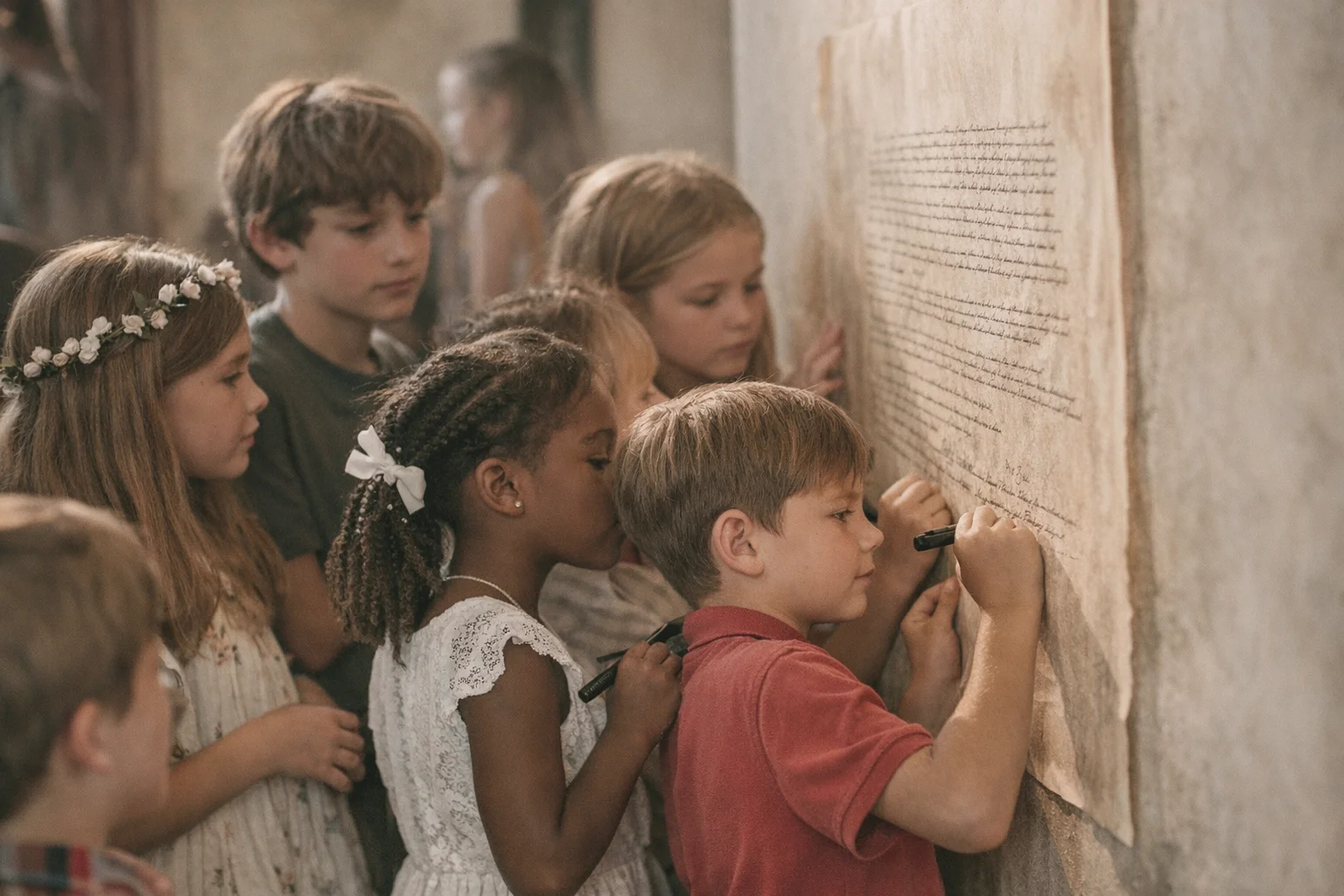
At the beginning of each session, the studio community drafts a contract that establishes the norms everyone agrees to live by. This contract covers everything from noise levels during focused work time to how conflicts will be resolved. Every learner signs it. And when someone breaks the agreement, it is the community, not the guide, that holds the conversation about what happened and what needs to change.
This peer accountability system is remarkably effective. Children care deeply about the opinions of their peers, often more than they care about the opinions of adults. When a fellow learner looks you in the eye and says, “You committed to finishing that challenge by Thursday and you did not follow through,” the feedback lands differently than when a teacher marks a zero in a gradebook. It is more personal, more immediate, and more likely to produce genuine change.
Running partners are another layer of this system. Each learner is paired with a peer who serves as an accountability partner, someone who helps them set weekly goals, checks in on progress, and offers honest encouragement. The guide facilitates these pairings but does not control the conversations. The running partner relationship is owned by the learners, and it builds the kind of deep, trust-based friendship that traditional schools rarely cultivate.
A Real Example of Guide vs. Teacher
Imagine a group of ten-year-olds working on an engineering challenge. They have been tasked with building a bridge from limited materials that can hold a specific weight.
In a traditional classroom, the teacher might begin with a lesson on structural engineering, show examples of bridge designs, demonstrate how to test for load-bearing capacity, and then let students try. If a group’s bridge collapses, the teacher explains what went wrong and suggests a fix.
In a guide-led studio, the challenge is presented without a lesson. Learners must research bridge designs on their own, test materials, make predictions, and iterate. When a bridge collapses, the guide does not explain the failure. Instead, the guide asks, “What do you think happened? What could you change?” The learners analyze, adjust, and try again. They might fail three or four times before they succeed.
The traditional approach is faster. The guide approach is deeper. The children in the second scenario do not just learn about bridges. They learn how to learn. They learn that failure is data, not disaster. They learn to trust their own reasoning. And when their bridge finally holds the weight, the pride they feel is earned in a way that following step-by-step instructions never produces.
Why This Approach Builds Independence
The ultimate goal of the guide model is to make the guide unnecessary. Every question a guide asks instead of answers, every struggle a guide allows instead of resolves, every decision a guide defers to the community instead of making unilaterally, moves learners one step closer to self-sufficiency.
This is what we mean by learner-driven education. It is not a slogan. It is a daily practice of trusting young people with increasing levels of responsibility and watching them rise to meet it. The guide is the person who holds the space for that growth to happen, not by controlling it but by believing in it fiercely and protecting the conditions that make it possible.
See Guides in Action
The guide model is one of those things that makes more sense when you see it than when you read about it. We invite families to visit Acton Academy College Station, sit in on a studio session, and watch what happens when an adult steps back and a room full of young people steps forward. It is quieter than you expect, more purposeful than you imagine, and more powerful than any lecture you remember from your own school days. Reach out to schedule a visit.