Why Report Cards Fail
Twice a year, millions of families receive a document that is supposed to summarize everything their child has learned, accomplished, and struggled with over the past several months. It arrives as a column of letter grades, perhaps with a few brief comments from a teacher: “works well with others,” “needs to improve focus,” “pleasure to have in class.” This is the report card, and for most families it is the primary window into their child’s educational life.
The problem is that report cards tell you almost nothing of value. A B-plus in math does not tell you what your child understands or what they are struggling with. An A in reading does not tell you whether your child loves reading or merely tolerates it. A C in science does not tell you whether the grade reflects a lack of understanding, a single bad test, or a mismatch between the child’s learning style and the teacher’s instruction method. Report cards reduce the rich, complex, deeply personal experience of learning into a handful of symbols that obscure far more than they reveal.
At Acton Academy College Station, we do not issue report cards. Instead, we have built a reflection process that asks learners to review their own growth, assemble evidence of their progress, seek feedback from peers, and set intentions for the future. It is more rigorous than a report card, more honest, and infinitely more useful.
The Self-Reflection Process
The end-of-year reflection process at Acton Academy College Station takes about a week and touches every dimension of a learner’s experience. It is not a casual exercise. It requires genuine introspection, honest self-assessment, and the willingness to confront both achievements and shortcomings.
Each learner begins by revisiting the goals they set at the start of the year. They pull out the journal entries from August or September and read what their younger self intended to accomplish. Did they achieve those goals? If so, what made success possible? If not, what got in the way? Was the goal itself unrealistic, or was the effort insufficient? These are searching questions, and learners are expected to answer them honestly.
The self-assessment extends to specific areas of growth. Learners evaluate their progress in core skills, reflecting on where they started, where they are now, and what they found challenging along the way. They assess their participation in quests, considering not just the quality of their final products but the quality of their process. Did they contribute to their squad? Did they take feedback well? Did they push through difficulty or retreat into comfort?
Character development is part of the reflection too. Learners consider how they have grown as members of the community. Were they kind? Were they honest? Did they uphold the studio contract? Did they support their peers? These questions matter at Acton Academy College Station as much as any academic measure, because we believe that who you are becoming is as important as what you are learning.
Portfolio Review: Evidence of Growth
The reflection process is grounded in evidence, not opinion. Each learner maintains a portfolio throughout the year that includes samples of their work, quest deliverables, writing samples, photos of projects, and recordings of presentations. During the end-of-year reflection, learners curate this portfolio, selecting pieces that represent their best work, their most significant growth, and their biggest challenges.
The curation process itself is a form of learning. Choosing which pieces to include requires learners to evaluate their own work critically. Why is this particular essay my best? What makes this quest project more significant than that one? Which piece shows the most growth from beginning to end? These judgments develop metacognitive skills that serve learners throughout their lives.
Portfolios also make growth visible in a way that grades cannot. When a learner places their September writing sample next to their December writing sample, the improvement is often dramatic and immediately apparent. When they compare their first quest presentation to their most recent one, the growth in confidence, clarity, and depth of understanding is unmistakable. This visual evidence of progress is far more motivating and informative than a letter grade could ever be.
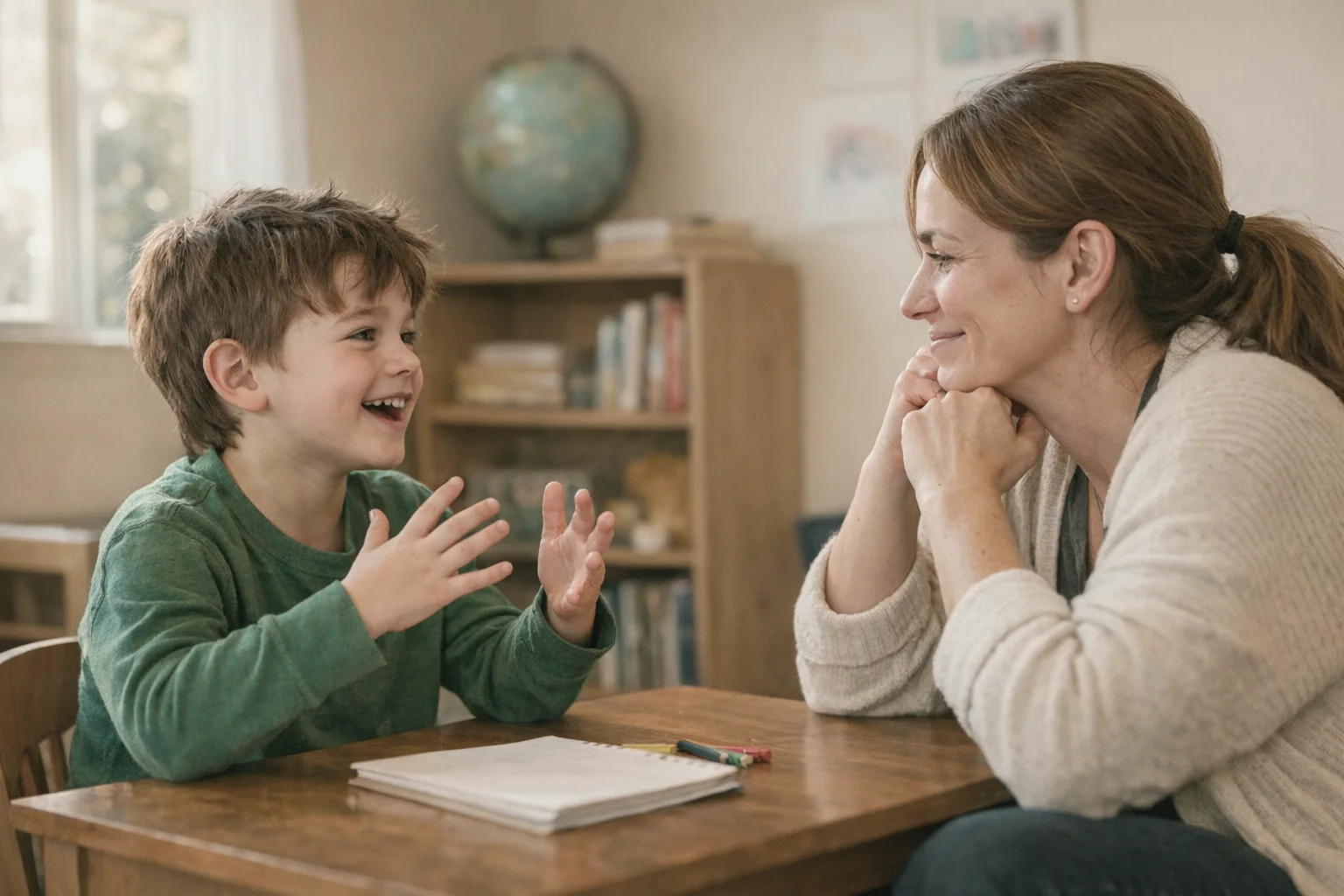
Parents are invited to review their child’s portfolio during the reflection period. Many parents tell us that this is the most meaningful school-related experience of the year. Instead of receiving a document full of letters and numbers, they sit with their child and hear them explain their own work, their own growth, and their own challenges. The conversation that results is richer, more honest, and more connected than any parent-teacher conference could be.
Peer Feedback from Running Partners
One of the most distinctive elements of our reflection process is the role of running partners. Throughout the year, running partners hold each other accountable, celebrate each other’s wins, and challenge each other to keep growing. During the end-of-year reflection, they provide honest feedback that complements the learner’s self-assessment.
The running partner feedback process is structured but not scripted. Partners sit together and discuss questions like: What is one area where you saw your partner grow the most this year? What is one area where you think they still have room to improve? What is something they did that you admired? What is something you wish they had done differently?
These conversations require courage from both parties. Giving honest feedback to a peer is hard. Receiving it is harder. But by the end of the year, running partners have built enough trust that the feedback is received as what it is: an act of care from someone who genuinely wants you to succeed.
The peer feedback often surfaces insights that neither the learner nor the guides would have noticed on their own. A running partner might observe, “You always help other people with their projects but you never ask for help with your own. I think you would grow faster if you let people help you.” That kind of observation is specific, personal, and actionable in a way that no report card comment could match.
Goal-Setting for the New Year
The reflection process does not end with looking backward. Its final stage is forward-looking: setting goals for the year ahead. Informed by their self-assessment, their portfolio review, and their running partner’s feedback, learners articulate what they want to accomplish next.
These goals are specific. Not “be better at math” but “complete the geometry module by March.” Not “be a better friend” but “check in with my running partner every Monday morning instead of waiting for them to check in with me.” Not “work harder” but “finish my core skills work by ten-thirty every day so I have more time for quest projects.”
Learners also identify the obstacles they expect to encounter and the strategies they will use to overcome them. This is not wishful thinking. It is planning with clear eyes and honest self-knowledge. A learner who struggled with time management this year and sets a time management goal for next year is building on real experience, not abstract aspiration.
The goals are shared with running partners, who will serve as accountability partners in the months ahead. They are also shared with parents, creating a bridge between the school and home environments that supports the learner’s growth from both directions.
What This Process Produces
The end-of-year reflection process produces something far more valuable than a report card. It produces self-awareness. A learner who goes through this process annually develops a sophisticated understanding of their own strengths, weaknesses, patterns, and growth edges. They learn to evaluate their own performance honestly, to accept feedback gracefully, and to set goals that are grounded in reality rather than fantasy.
This self-awareness is a lifelong asset. Adults who can accurately assess their own performance, seek feedback from trusted peers, and set meaningful goals are adults who continue to grow regardless of their circumstances. The reflection skills our learners develop at Acton Academy College Station do not expire when they leave our studios. They carry forward into high school, college, careers, relationships, and every other arena where growth matters.
Parents consistently tell us that the reflection process transforms how they understand their child’s education. Instead of a letter grade that raises more questions than it answers, they sit across from a child who can articulate what they struggled with, what they are proud of, and what they want to tackle next. As Laura Sandefer describes in Courage to Grow, this kind of honest self-assessment is one of the most valuable skills a learner can develop.
A Different Measure of Success
We understand that the absence of report cards can feel unsettling for families who are accustomed to them. Letter grades provide a familiar shorthand, a quick way to answer the question “how is my child doing?” But we believe that question deserves a better answer than a letter on a page.
How is your child doing? They are reading fifty pages a week more than they were in September. They led a squad for the first time and navigated a conflict without guide intervention. They went back to fill a foundational math gap and are now progressing faster than ever. They gave a presentation at exhibition that made the audience ask questions for twenty minutes. They wrote a reflection acknowledging that they need to work on listening to teammates. That is how your child is doing. And no report card in the world could tell you that.
Come See Our Approach in Action
If the idea of portfolios, peer feedback, and self-directed reflection sounds compelling to you, we invite you to visit Acton Academy College Station and see it in person. Watching a learner walk their parents through a portfolio, pointing to evidence of their own growth, is one of the most powerful moments in our school year. We would love for you to experience it. Reach out to schedule a visit or attend one of our upcoming open houses.