Why Traditional Discipline Fails
Most schools handle conflict the same way they handle everything else: from the top down. A child misbehaves, and an adult delivers a consequence. Detention. A note home. A color change on the behavior chart. The child endures the punishment, the incident is filed away, and everyone moves on until the next disruption.
The problem with this system is not that it is too harsh or too lenient. The problem is that it teaches nothing. The child who serves detention learns that getting caught has unpleasant results. He does not learn why his behavior hurt another person. He does not practice repairing the harm. He does not develop the internal compass that would prevent the behavior in the first place. He learns to avoid consequences, not to grow character.
At Acton Academy College Station, we believe conflict is not a disruption to learning. It is learning. When two learners disagree about how to divide quest responsibilities, that is a leadership lesson. When a learner says something hurtful and watches the impact land on a peer’s face, that is an empathy lesson. When a community standard is violated and the community must decide how to respond, that is a civics lesson. None of these lessons happen when an adult swoops in, renders judgment, and sends everyone back to their seats.
The Peer-Led Process, Step by Step
When a conflict arises between learners at Acton Academy College Station, the process follows a clear sequence that the learners themselves manage. The role of the guide is to observe, to intervene only when safety is at stake, and to ask questions that help learners navigate the process rather than to dictate outcomes.
The first step is a cooling-off period. When emotions are running high, productive conversation is impossible. Learners involved in a conflict are encouraged to take space, breathe, and wait until they can speak calmly. This is not a punishment. It is a practical recognition that human beings think better when they are not flooded with anger or hurt.
The second step is a one-on-one conversation between the learners involved. They sit down together, often in a quiet area of the studio, and each person shares their perspective using a simple framework: What happened? How did it make you feel? What do you need going forward? The other person listens without interrupting. Then they switch roles. This structure ensures that both parties feel heard, which is the single most important factor in resolving any conflict.
The third step is reaching an agreement. The learners decide together what needs to happen to repair the harm and prevent a recurrence. This might be a sincere apology, a change in behavior, a commitment to check in with each other the following day, or a request to involve a third-party mediator if the two-person conversation did not resolve things fully.
The fourth step, if needed, is community involvement. If a conflict affects the broader studio, if a studio contract agreement has been violated, or if the learners cannot reach resolution on their own, the issue comes before the community. The studio gathers, hears from both sides, discusses the situation, and decides together what the appropriate response should be. This is not mob justice. It is democratic governance practiced by young people who take their community seriously.
The Role of the Studio Contract
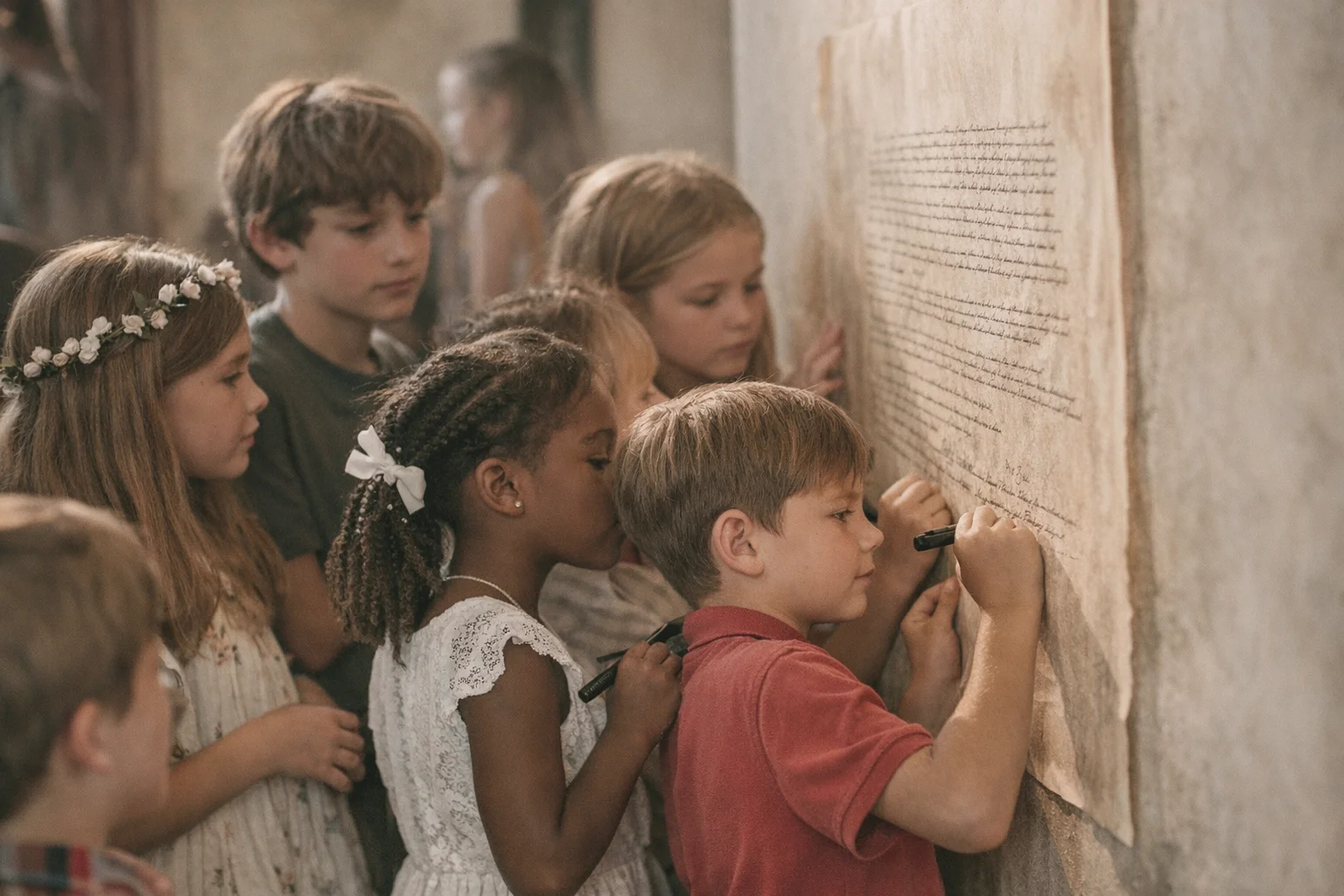
The studio contract is the foundation on which all conflict resolution rests. At the beginning of each session, learners collaboratively create a set of agreements that define how they want to live and work together. These are not rules imposed by adults. They are commitments that the community makes to itself.
A typical studio contract might include agreements like: We will speak honestly and kindly. We will do our best work. We will resolve conflicts directly rather than through gossip. We will respect shared spaces. We will hold each other accountable with courage and compassion.
When a conflict arises, the studio contract provides a shared reference point. The question is not what does the teacher think you should have done? The question is what did we agree to, and did we live up to it? This shift matters enormously. When a child is measured against a standard she helped create, accountability feels fair rather than arbitrary. She is not being punished by an authority figure. She is being held to a promise she made to her own community.
The studio contract is also a living document. If the community discovers that an agreement is unclear, unrealistic, or missing entirely, they revise it. This process of ongoing negotiation teaches learners that governance is not static. Rules exist to serve people, and when they stop serving, they should change.
When Conflicts Escalate
Not every conflict resolves neatly in a single conversation. Some conflicts are deeply personal, involve repeated patterns, or touch on issues that young people do not yet have the tools to navigate alone. In these cases, guides step in more actively, not to impose a solution but to provide scaffolding.
A guide might meet separately with each learner to help them articulate what they are feeling and what they need. She might facilitate a structured conversation using a specific protocol. She might suggest a restorative circle where the broader community acknowledges the harm, hears from the affected parties, and collectively develops a plan for moving forward.
In rare cases involving safety concerns, guides act immediately and decisively. Physical aggression, threats, and behavior that puts any learner at risk are not processed through the standard peer-led sequence. They are addressed by adults in the moment, and the community processes the incident afterward. The line between learner-led conflict resolution and adult responsibility for safety is clear, and guides are trained to recognize it instantly.
Parents are informed when significant conflicts arise, and we communicate openly about what happened, how it was handled, and what your child’s experience was. We do not sugarcoat. We also do not catastrophize. Conflict is a normal part of community life, and how a community handles it says far more about its health than whether conflict exists at all.
How This Builds Stronger Adults
The skills learners develop through our conflict resolution process are among the most practically valuable things they take from Acton Academy College Station. Consider what a learner who has spent years resolving conflicts through direct conversation, honest listening, and collaborative problem-solving looks like at eighteen, at twenty-five, at forty.
She can walk into a difficult conversation with a roommate, a colleague, or a partner without avoiding, exploding, or shutting down. He can hear criticism without crumbling and offer criticism without cruelty. She can disagree respectfully, hold a boundary firmly, and repair a relationship after a rupture. He can recognize when he is wrong and say so out loud.
These are not soft skills. They are essential life skills, and most adults stumble through them because nobody taught them the mechanics of honest communication when they were young enough for it to become second nature. Our learners practice these mechanics every week, in real situations with real stakes, surrounded by a community that expects both courage and compassion.
The world does not need more people who know how to avoid getting detention. It needs people who know how to navigate disagreement, repair harm, and build communities that hold together under pressure. That is what our learner-driven approach to conflict resolution is designed to produce, and it is one of the things families in College Station value most about this school.
If you want to see how this looks in practice, we invite you to visit. Ask our learners about the last conflict they resolved. Their answers will tell you more about the culture of this community than anything we could write here.